ULTIMATE AFRICA SAFARIS
Phone toll free 1 800 461 0682

Ultimate Africa travel and wildlife news archive

August 2000

Visitors to Zimbabwe Impressed Despite Politics, August 6 2000

"Thank you for coming to Zimbabwe, madam." The young vendor in the craft village at Victoria Falls could have been speaking for the entire tourism industry. Normally bustling with souvenir hunters from many parts of the world, drawn to the magnificent spectacle of the largest single waterfalls on earth, the Victoria Falls craft center with its array of splendid wood and stone carvings, baskets, drums and other distinctive African items is almost empty.

High above it, a tethered helium balloon offers sightseers a lofty view over the dramatic gorge of Victoria Falls. The Zambezi is running high, and the mile wide cataract is an awesome sight as it plunges into the deep chasm, throwing up clouds of rainbow spray.

Even before you land at the Victoria Falls Airport the Falls are an image to remember - a mile long slash of spray rising from the flat Zambezi valley. The thunder comes when you get up close and personal.

The locals call it "Mosi OA Tunya", the Smoke that Thunders. It's the greatest show on earth, and it has been running for 300 million years or so. David Livingstone, the fabled missionary explorer who was the first white man to see the falls in 1856, naming them for his queen, was moved to write in his journal that "Scenes so lovely must be gazed upon by angels in their flight."

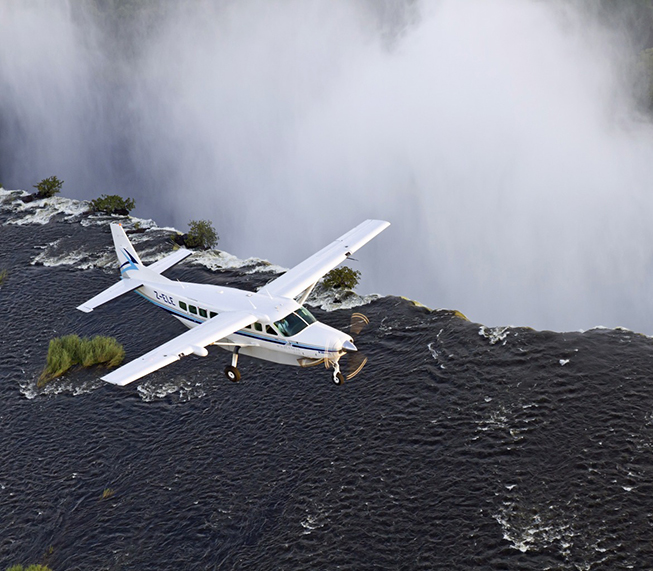
The Flight of Angels, a throat-catching low-level pass by light aircraft or helicopter over the length of the mighty waterfall and up the broad Zambezi, still operates as often as there are clients wanting the ride. The flight is one of the "must-dos" among great many things to do at this famous destination.

Today the streets and hotels and shops of Victoria Falls are unusually quiet. Political violence in parts of Zimbabwe in the run-up to the June parliamentary elections, and the negative publicity associated with it, has resulted in widespread uncertainty about the advisability of traveling to the country. Sadly and undeservedly it has been perceived as an 'unsafe' destination, and tourism has suffered accordingly.

A concerted recovery program is now being implemented to turn the industry around. It's still business - if not "as usual" - at Victoria Falls. Travelers from many parts of the world continue to find there the African experience of a lifetime. In the Victoria Falls rain forest travelers stare across a narrow gorge at a solid curtain of white water. The sodden earth underfoot seems to vibrate with the pounding, and the uprush of spray-filled air from the hundred-meters deep chasm drenches the onlookers. Holly Jenkins is in tears. "This must be one of the most special places on earth," shouts Holly Jenkins, from South Carolina, United States, above the roar of the great waterfall. "I feel... that I am standing... on sacred ground."

Given what she had been reading in the newspapers and seeing on television, did she have any qualms about coming to Zimbabwe? "Some," she says. "But we were guided by our travel professionals, and they said we had nothing to worry about. They were right - we have not felt at all threatened or unsafe. Everybody has been friendly and helpful and we have felt secure and welcome. It has been the most wonderful experience."

Holly and her sister Meredith have brought their mother to see Victoria Falls. A spry 87-year-old, Gloria Maynard had put it high on her list of life's unfinished business.

Not far from where Holly stands thrill-seekers are queuing to throw themselves off the graceful old steel bridge that arches over the Batoka gorge, linking Zimbabwe and Zambia. Tethered by their ankles, they are experiencing the second highest commercial bungi jump in the world, an adrenaline rush of superlative proportions. Their progress can be watched through binoculars from the clipped lawns and terraces of the gracious and world renowned old Victoria Falls Hotel, which occupies pride of place facing out high over the bridge and the Zambezi gorges.

Farther down the churning river, other hardy souls cling to rubber rafts riding the rollercoaster rapids of the Zambezi as it boils through seven snaking gorges that mark the past deep gashes of the waterfall as it cut its way upriver over hundreds of millions of years.

Above the falls, canoeists paddle the broad reaches of the great river, the insistent tug of the current taking them close past feeding elephants while giving the hippo pools and crocodiles a wide berth.

Soon the sundowner cruise launches will cast off and ply their leisurely way upriver, carefully timing the passage so that they turn and drift homeward as the sun sinks in molten splendor into the river. It's a nightly ritual that never fails to enthrall.

Perhaps the most privileged view of the Zambezi sunset is that served with champagne in the bygone trappings of a refurbished old railway carriage drawn by a splendid steam locomotive, which hisses to a halt in the middle of the Victoria Falls bridge and later steams leisurely back to quaint Victoria Falls station.

As darkness settles, sharpening the lights of the hotels and lodges and campfires, the muted roar of the great waterfall seems to amplify in the still night air, a pervasive and vaguely ominous susurrus behind the distant drumbeats and other sounds of the African night.

At full moon, the pallid luminescent beauty of the lunar rainbow rewards those who venture to the chasm at night. Guided every step of the way in small strictly controlled groups, it is not a night stroll for the timorous.

Victoria Falls is many things to many people, the backpacker and the five-star sophisticate, the camper and the casino-phile, the adventurer and the aesthete. Generations of travelers have come and will continue to come here; to see, to marvel, to touch and be touched, and to go away changed forever.

Holly and Meredith are taking their mother home the next day after an unforgettable African adventure that started weeks earlier in Cape Town, finally reaching the banks of the Zambezi River at Victoria Falls. Says octogenarian Gloria: "I guess you could say we left the best to last."

Comments from Zimbabwe’s Chikwenya Camp, August 6 2000

Julien and Annie Roelants of Travel Worldwide Belgium wrote of their recent visit to Chikwenya Camp adjoining Zimbabwe’s Mana Pools National Park: 'We have visited some of the most famous places and lodges of Southern Africa but without any doubt Chikwenya beats most of them. Our hosts Mark and Alison did their utmost to make us a comfortable as possible, our guide Jo was very knowledgeable and the rest of the staff did a wonderful job. Chikwenya and it's surroundings has a lot to offer and we will certainly recommend it to our clients as well as to our friends. Thanks for an unforgettable private dinner with an elephant that came so close we could offer it a glass of champagne'.

Zimbabwe Dollar Devalued, August 6 2000

The Zimbabwe government has devalued its currency by 32% against the US dollar, to 50 Zimbabwe dollars to 1 US dollar, with immediate effect.

Before the announcement, the Zimbabwe dollar had been trading at around 38 to the US dollar.

Zambia's Songwe Village, August 6 2000

Kwando Safaris has taken over the running of Songwe Point Village near Victoria Falls in Zambia. The lodge is perched 120meters (roughly 360 feet) above the Zambezi River downstream from the Victoria Falls. Guests are accommodated in 8 spacious thatched huts and all are equipped with modern amenities and spectacular views. Activities include an ox cart visit to human origins museum at Songwe, a visit to the Mikuni village, guided tours of the Falls, Zambezi River boat cruises, a visit to the Mosi-a-Tunya Nature Sanctuary to view white rhinos, and a visit to the nearby Livingstone Museum.

Cape Town’s Chapman's Peak Road to Partially Reopen, August 6 2000

A 1.5-km stretch of Cape Town’s Chapman’s Peak road will reopen after being closed for six months due to rock falls earlier in the year. The long-awaited reopening of the section near Hout Bay, one of the world's foremost scenic coastal drives, will enable vehicles to reach the highest viewing spot. It is anticipated that the entire road will be opened by February 2001 in time for the Cape's famous annual Cycle Tour.

Penguin Clean-up Completed, August 6 2000

The massive operation to rehabilitate thousands of penguins coated in oil from a sinking bulk-ore carrier off Cape Town six weeks ago, has finally been completed.

Cheers, tears and corks popped as the final penguin emerged from the froth of the washroom at Cape Town's Salt River penguin crisis center. "Just unbelievable," noted Ken Brewer, who headed the activities of the rehabilitation center. Center volunteers washed 14,549 penguins since the "Treasure" sank, said. "It has been the most incredible effort by our team - these birds were among the worst oiled we've ever seen and, in some cases, have needed up to 13 washes each," he added. His volunteer staff has been working 16-hour days to achieve the goal of washing 500 birds a day.

The washroom - a former derelict railway warehouse - was set up shortly after the world's biggest ever wildlife rescue began when a ship spilled a cargo of 1,300 tons of fuel oil into the seas just off Cape Town, endangering 41 percent of the African Penguin population.

International Fund for Animal Welfare joined hands with the South African Foundation for the Conservation of Coastal Birds or SANCCOB in the rehabilitation effort. Its team of more than 40 of the world's top oiled wildlife experts from the US, UK, France, Canada, Brazil, Australia, and Singapore began arriving in South Africa within 48-hours of the spill.

The total cost of SANCCOB's rehabilitation effort has yet to be finalized but is estimated to be in the region of two million US dollars.

The washing of the oiled penguins is the first step in their rehabilitation and it is expected to take between two to three months before the last penguin will be able to be released by into the wild.

Police Deployed to Protect Visitors Leaving Kruger, August 6 2000

A team of 30 policemen has been deployed to patrol roads around South Africa’s Kruger National Park following three hijackings of foreign tourists leaving the Park in six weeks. The patrols will focus mainly on the routes between Hazyview and the Kruger and Numbi gates.

Rhinos Darted in Mpumalanga's First Eco-Hunt, August 6 2000

Three white rhinos were darted in the Loskop Dam Nature Reserve, Mpumalanga, South Africa recently. The "hunt" was the first since the cash-strapped Mpumalanga Parks Board introduced the concept of eco-hunting into its reserves. The idea is that hunters pay to dart animals that need to be moved to other reserves or fitted with microchips for tracking purposes. This particular hunt funded the microchipping of two of the rhinos and the translocation of a bull to the Ohrigstad Dam Nature Reserve.

Kenya To Rehabilitate Nairobi Airport, August 6 2000

The Kenya Airports Authority plans to carry out a major rehabilitation program of Nairobi’s Jomo Kenyatta International Airport.

Kenya Tourism Officials Hopeful, August 6 2000

Kenyan tourist officials recently noted that they were cautiously optimistic that the troubled sector could climb out of its current slump over the next year. Kenya's fortunes took a turn for the worse in 1997 after politically-motivated ethnic clashes along the Indian Ocean coast tarnished the country's reputation. Shortly afterwards, heavy El Nino rains literally washed away the country's already-poor roads. Currently the country is facing severe power and water rationing as it suffers a severe drought. To add to the country's woes tourists have been abandoning Kenya in droves as they have been eyeing other destinations such as Tanzania, Zimbabwe, South Africa and Botswana with higher quality wildlife viewing and guides.

Despite these factors tourism industry officials said aggressive marketing by the Kenya Tourist Board and private sector initiatives had now encouraged tourists to consider Kenya again. Still, unreliable water and electricity supplies due to a prolonged drought, poor roads and low standards of service have continued to undermine recovery efforts. "After three long years of downhill we are at long last beginning to climb out of the slump," said Kuldip Sondhi, the chairman of the Mombasa and Coast Tourism Association. "But we need the government to repair the last bit of infrastructure especially roads, provide sufficient and uninterrupted water supply and ensure that electrical power begins to flow to our circuits steadily. We will then be on the road to recovery."

Eclipse Fever Grips Africa, August 13 2000

The next total eclipse of the sun anywhere in the world passes over the African continent from Angola to Madagascar on June 21, 2001. The top spot to see it is Zambia. There, hotels, camps and game lodges have been fully booked for more than a year, although efforts are now being made to increase capacity.

June is in the middle of the dry season in this part of Africa. Clear blue skies are common place and the chances of seeing the full show are exceptionally good.

In Zambia preparations for an unknown number of visitors are under way. UK eclipse expert Professor John Parkinson has just returned from Lusaka where he has been offering advice to the authorities. He is an eclipse chaser and has seen eight total eclipses so far. In Zambia, he believes the view will be excellent. "The corona will be really spectacular because the atmosphere is so clear. It is going to be one of the best eclipses we have ever seen," he says.

It is the chance to combine the eclipse with a safari which for many is proving so appealing. Professor Parkinson is looking forward to seeing how big game reacts as day turns to night for three and a half minutes in the middle of the afternoon.

Crocodile Attacks Man in Tent, August 13 2000

A man was attacked by a crocodile in his tent in Botswana’s Moremi Game Reserve in Botswana last Tuesday. The incident took place in the same camp where an American boy was dragged from his tent and killed by hyenas recently. According to reports the crocodile dragged a safari company driver from his tent. However, he managed to grab hold of a steel pole, thereby saving his life. A Botswana Defense Force helicopter rushed him to a hospital in Maun.

According to safari operators, the two attacks are apparently the first to have occurred in Botswana in many years.

Botswana Electrifies Fence Along Border With Zimbabwe, August 13 2000

Botswana has electrified a 30-km double barrier fence on its border with Zimbabwe to control livestock movement between the two countries. The Botswana veterinary authorities in the central district say that the new fence would also control wild animals, which usually break through the border area. Botswana, a leading cattle rearing country, took the measure to curb the spread livestock ailments like foot and mouth disease from one country to another. Currently, cattle from Botswana which cross into Zimbabwe are killed within 24-hours of their return. The owners of the cattle are then compensated for the loss. However, Zimbabwean cattle which cross into Botswana are returned back.

Though the fence will stop cattle movement between the two countries, Botswana wildlife officials fear that it would aggravate the problem of rogue elephants which have been destroying property in the central district. In 1999, there were 50 reported cases of elephants damaging property in the area.

Botswana’s has exceeded its environment’s elephant carrying capacity, and now that the animals will no longer have the freedom of movement as before in the area, wildlife officials fear that they would pose a greater menace to residents.

Kenya Drought Causes Conflict, August 13 2000

The ongoing drought in Kenya is causing wildlife to invade local farms in search of water and food. However, the destruction of crops and threat to human life has reached such proportions that local people now threaten to kill the animals if the government does not act soon.

Elephant and buffalo are among the animals causing the biggest damage. Apart from destroying crops, elephants are also preventing children in the area from going to school for fear of being trampled.

Despite efforts by the Kenya Wildlife Service to keep wildlife within the confines of national parks, the famished animals are breaking through fences to get to water and food on surrounding farms.

Africa's Rhinos on the Increase, but no Room for Complacency, August 13 2000

In a joint media release the World Conservation Union (IUCN) and the World Wide Fund for Nature (WWF) announced that numbers of Africa's two rhino species are on the increase. Populations of both black and white rhino are reportedly increasing in the wild according to new estimates released by the two conservation organizations.

The latest estimates, prepared by IUCN's African Rhino Specialist Group, show that there are now more rhino in Africa than at any time since the early to mid 1980s. "Even though overall numbers are positive, there is no room for complacency," said Dr Martin Brooks, Chairman of the Specialist Group. He said that numbers of two of the six African rhino subspecies remain very low.

New Mozambican Resort to Open in 2001, August 20 2000

The Margaruque Island Resort will open August 2001. This will be the sister lodge to Sanyati on the shores of Lake Kariba in Zimbabwe. The resort will be built on an island in the Mozambique Bazarutto Archipelago. The Margaruque island resort will have the following amenities: three types of chalets (48 beds in total), central main lodge, pool and bar area, conference center and water sport center.

The 16 thatched air-conditioned chalets will be detached with unobstructed views towards the sea. Accommodation consists of 10, one-bedded roomed chalets with ensuite bathroom and lounge, leading out onto a timber deck and plunge pool. Five, two - bedroom chalets, with ensuite bathrooms, and a central lounge, situated between the two bedrooms, leading out once again onto the timber deck, outside shower and plunge pool. One, four - bedroom chalet, constructed on two levels. Each of these rooms will have private ensuite facilities and two rooms will have sundecks overlooking the pool deck.

The central living area includes a large pool, restaurant, outside dining terrace, reception, wine cellar, cigar room, curio shop, children’s play room, snooker room and bar.

The watersports center will adjoin the main living area and includes a gym and aerobic room massage rooms, a hot and cold plunge pool, a dive center and a juice bar.

Access to the island will be by boat from Vilankulos.

Cape Town Airport to Expand, August 20 2000

The Cape Town International Airport (CIA) is set to develop into one of Africa’s largest airports with the implementation of a R500 million (US $82 million) phased upgrade. The airport currently handles about four million passengers annually. According to International Air Transport Association (IATA) air traffic forecasts, this will increase to 12 million a year by 2015 and 24 million annually by 2030. IATA also predicts that more direct intercontinental flights will link CIA with Europe and the USA.

South Africa’s Cape to Boast "Mega Nature Reserves", August 20 2000

Conservationists are planning to launch a five-year fundraising program to establish three new "mega nature reserves" in South Africa’s Cape Region. These reserves will stretch from the Cedarberg in the Western Cape to the Baviaanskloof in the Eastern Cape. The program will be co-ordinated by the World Wide Fund for Nature (SA) and financed by the Global Environmental Facility and the Cape Action Plan for the Environment(CAPE) project.

The project will be aimed at developing a long-term strategy that will ensure the conservation and sustainable use of the Cape floristic region and its adjacent marine ecosystems. The Cape’s unique lowland habitats are under serious threat from human activities such as agriculture and forestry, the newspaper reports. The Cape floral kingdom contains the highest concentration of endangered plant species in the world per square meter of land.

South Africa’s First Transfrontier Park Proves Successful, August 20 2000

July was a great month for the new Kgalagadi Transfrontier Park, which incorporates parks in Botswana and South Africa, with the park having been fully booked for the month and showing "great bookings" for the rest of the year. This can be mainly attributed to the merging of the two countries’ parks and the extensive national and international media coverage received.

No passports are required for tourists moving within the park although it covers two countries.

Rovos Rail Steams Ahead with New Journey, August 20 2000

Rovos Rail, one of South Africa’s most luxurious train travel experiences, will use its ‘Pride of Africa’ locomotive on a new annual journey, the first of which will leave Pretoria on May 31, 2001. The eight-day trip will take in the splendors of South Africa from Pretoria to Cape Town, but also incorporate stopovers in Mozambique and Swaziland.

The journey will start at Rovos Rail Station Capital Park in Pretoria where it will move in an easterly direction through the lowveld and Drakensberg escarpment of Mpumalanga en-route to Mozambique. After a short visit to Maputo, the train will continue its journey southwards through Swaziland to the Hluhluwe Game Reserve in KwaZulu Natal.

Passengers will be able to partake on an early morning game drive and visit historical sites and also the World Heritage Site at St. Lucia. After an evening in Durban, the train ascends through the Valley of a Thousand Hills past Lesotho and the highest mountains in the Drakensberg range. The train then passes through Bloemfontein, the Free State capital, moving southwards before reaching the historical town of Graaff Reinet in the Eastern Cape.

The train will then proceed in a westerly direction towards Oudtshoorn in the Western Cape. Passengers will visit the Highgate Ostrich Farm after which the train will descend through the Outeniqua Pass into George. Passengers can enjoy a morning visit to Knysna before the train continues its journey through the Garden Route past Mossel Bay and Riversdale. After a short visit to the KWV Brandy Distillery in Worcester, the Pride of Africa ends its journey in Cape Town.

The reverse leg departs on June 9 with a similar itinerary.

Nairobi Runs out of Water, August 20 2000

The capital city of Kenya, Nairobi, has been doing without the essentials of life recently. There have been power cuts to homes and offices. Maasai herdsmen with their cattle have been seen looking for green pastures in residential areas, posing a new hazard to the city motorists. As if that is not enough, the city residents now have to cope with an acute shortage of water.

All these woes are blamed on the worst drought in 30 years, which has dried up rivers, hydroelectric dams and water taps. There are long queues everywhere as people wait for hours to fill their jerrycans. And men and woman admit openly they have gone without a bath or clean clothes for weeks. "We don’t have baths anymore," complains one Nairobi resident. "We don’t wash out clothes. There’s no water anywhere."

For months now, the water levels in the reservoirs have been dangerously low. A month ago Nairobi City fathers imposed water rationing in the city, and only managed to make matters worse.

Contaminated water is being sold to thirsty city residents, and the city could also be facing a severe health crisis. There are blocked toilets in hotel rooms.

Drought Drives Farmers into Kenyan National Reserve, August 20 2000

The prolonged severe drought in east Africa has dried up crops and pastures, forcing some farmers and nomads to invade Kenya’s national parks for survival. Over 6,000 farmers have invaded parts of Kenya’s Mount Kenya Forest Reserve. They have cultivated an estimated 10,000 acres of land threatening massive environmental degradation in a region that is also a leading water catchment area.

Mount Kenya Forest, which covers 715 square kilometers in central Kenya, has been listed as a natural treasure by the United Nations Educational, Scientific and Cultural Organization. The farmers have put up makeshift shelters in the forest, with which they guard their farms from wildlife attacks.

Kenya Wildlife Service Staff Accused of Brutality, August 20 2000

The management of more than 2,000 square kilometers of exotic forest reserve on Mt Kenya was placed under the Kenya Wildlife Service (KWS) last month in an effort to end the increasing destruction of the vegetation. However, concerns are allegedly being raised about the manner in which the KWS rangers were going about evicting those who have been cultivating in the forests.

Kenya Wildlife Service (KWS) rangers have been accused of beating up innocent people under the guise of implementing their new mandate to run the Mt Kenya Forest Reserve. Allegations have also been made that the rangers were soliciting bribes and those who failed to pay were held on trumped-up charges.

Clinton to Include Tanzania in African Trip, August 20 2000

U.S. President Bill Clinton will stop in Tanzania during his African tour this month, the White House announced last Wednesday. It was reported that Clinton will go to Tanzania on August 28 at the invitation of former South African president Nelson Mandela, who is now mediator of the Burundian peace process.

Mandela has set August 28 as the deadline for the signing of a comprehensive peace agreement that will end the seven-year-old war in Burundi. Clinton may join Mandela in Tanzania, where the proposed agreement is expected to be signed, to show U.S. support for the Burundi peace process.

Illegal Ivory Seized in Egypt, August 20 2000

Egyptian authorities have seized more than 1.5 tons of uncut ivory smuggled from Sudan. It is reportedly one of the largest seizures ever in the region. Two Egyptians and one Sudanese were arrested on smuggling charges. Egypt became a member of the Convention on International Trade in Endangered Species (CITES) in 1978.

Zimbabwe Wildlife May Face Disaster, August 20 2000

The Zimbabwe government policy of redistributing land owned by white commercial farmers threatens "ecological disaster", according to an eminent conservationist.

Professor Johan du Toit, of Pretoria University, South Africa, says it is "inevitable that wildlife populations will be overhunted" if the farms are handed over immediately to black Zimbabweans.

He warns that the country’s black rhinos, one of the species that attracts high spending foreign tourists and hunters, will be at great risk. But he believes international help could avert the disaster.

Professor du Toit, director of the Mammal Research Unit at Pretoria University, says commercial white-owned farms in Zimbabwe are home to many rare large mammals, including cheetah, black rhino and sable - a type of antelope. "White-owned commercial farmland and ranchland in Zimbabwe supports a very significant proportion of that country’s biodiversity. It will be severely impacted if this land is thrown over to subsistence agriculture" he states. "The issue is that dumping impoverished peasants on geometrically-plotted patches of virgin non-arable land, without any infrastructure, tillage equipment, venture capital, housing, water supplies, or training will result quite simply in an ecological disaster," says Professor du Toit. "Wildlife populations will be overhunted and snared, habitat loss will be rapid, and the whole crisis will just get exponentially worse."

Professor du Toit acknowledges that Zimbabwe itself cannot afford to provide that sort of infrastructure. But he believes the international community would assist if the land redistribution was drawn up transparently and if the government completely revised its policy.

He believes Zimbabwe can still find a solution. But if it fails to do so, he thinks the future is bleak. "We’re going to lose some large populations and some important gene pools in the near future," says Professor du Toit.

Elephant Tramples British Tourist in Kenya, August 27 2000

A British tourist has been trampled to death by an elephant in Kenya's famous Masai Mara game reserve. Edward Harrison, 28, from the English town of Rugby, was killed after he left the safety of his tent last Sunday morning to try to get closer to a group of elephants he was photographing, Kenya Tourist Board (KTB) spokeswoman Avril MacDonald said. "When he didn't return, others went to look for him and found his body."

Tanzania, U.S. to Sign Open Skies Agreement, August 27 2000

Tanzania and the U.S. will sign an open skies agreement when President Bill Clinton visits the country. The agreement which removes restrictions on capacity, type of aircraft and frequency of flights between the two countries allowing for direct flights is expected to boost Tanzania's tourism earnings.

Most U.S. tourists currently travel to Tanzania via Europe.

Zambian Police Seize Illegal Ivory, August 27 2000

Zambian police have arrested five suspects near Mumbwa and recovered 14 pieces of elephant tusks which were being delivered to Lusaka. One of the suspects was a woman who was in possession of large chunks of dried game meat. The tusks could have been obtained from Kafue National park in Mumbwa area.

Harare’s Barker’s Lodge Not Closed, August 27 2000

One of Harare’s leading lodges, Barkers Lodge, is still operating contrary to reports that it had closed.

According to the owner, Yveitte Barker, many people thought that the the lodge had closed following an auction held at Barkers Lodge by Peter Lovemore on behalf of Hammer and Tongue Auctioneers, two weeks ago. "We are still operating. Everything is under control, people were confused by the auction which was held here and they thought that we were closing our lodges," said Barker. Some people were spreading rumors that we were auctioning our property for closure," she added.

Africa's Whale Watching Industry Booming, August 27 2000

A study undertaken by the International Fund for Animal Welfare (IFAW) revealed that tourist outings to watch whales and dolphins in the wild have become a huge international business.

According to the IFAW report, Africa now has the fastest growing whale watching tourism industry, followed by Central America. The United States accounts for almost half of the global industry.

Return to Weekly Update Archive