ULTIMATE AFRICA SAFARIS
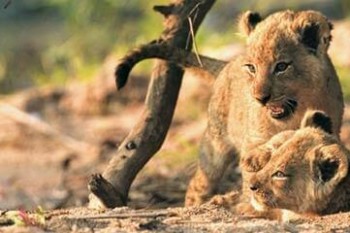
Ultimate Africa travel and wildlife news archive October 2003 Robin Pope's Weekly Zambia Update, October 5, 2003 Robin and Jo Pope run several very successful safari camps in Zambia. Here is their weekly update: I have just come back from a couple of days off in Lusaka so am full of the joys of spring. A couple of days is quite long enough in the big smoke and I did enjoy the novelty of eating out and choosing what to eat from a menu and ordering take away pizza! As you can see it doesn't take much to make me happy. I also had a new glam hair do, however, on returning all I seem to be attracting are geckos! First one fell on my head and then this morning I was sitting have my morning wake up coffee at 6:15 AM when I felt a thump on my back. I leapt up with a screech, fearing that a snake had fallen onto me from the roof. Kipe, one of the airwaves pilots had to come to my rescue and take 2 geckos from my back. Nervous laughter followed as I had a quick look up at the rafters to see if these geckos had jumped to escape the jaws of a predator, I then made a hasty retreat to my office. Shanie is on good form and wandering around showing her thigh to anyone who is interested... She was stung by a bee yesterday and the guys are all queuing up to inspect the damage - needless to say Simon is beating them off with a stick. The Nsefu lion cubs have appeared earlier than expected and are proving very popular with guests and staff alike. The lioness introduced the 2 males and a female to the pride a few days ago and they look to be only about 4 or 5 weeks old. It is fascinating to watch them playing and interacting with the rest of the pride, who seem quite happy for the guests to sit and watch them. Their are also 2 lactating leopards in the area and I am sure that it is just a matter of time before they are seen too. Paul had the great fortune of finding a herd of some 30 wildebeest at the salt pan the other day - great to see them back after a long absence. And Jacob continues to spot a whitewinged tern at Casicisi lagoon. Meanwhile still on the cub theme, Marcus had a super sighting of a leopard cub whilst walking with guests near the Nkwali pontoon. New life seems to be appearing everywhere. The mobile safaris have now finished for another season and certainly went out with a bang. Daudi took 6 American guests for the last mobile, all of whom had been friends since school and by all accounts had a ball. They were lucky enough to have good sightings of eland, buffalo and 3 lions on walks. However, the best was definitely left until last. Driving back from the Mupamudzi site 2 caracals were spotted in the road just by Zebra Pans and then to the amazement of all a 3rd appeared and they all trotted down the road in front of the car before disappearing off into the bushes - a very clear sighting and quite rare. As if this was not enough 8 roan antelope were then seen near Lundu plains just after the big baobab. A great finale for the mobile crew. Stay well and have a great week, Cheers - Kim Rekero Tented Camp, October 12 2003 Rekero Tented Camp is located in Kenya's Masai Mara Conservation area. Here is the camp's latest update: After a very busy September we are now into the end of the migration or so it feels, although there are still huge concentrations of wildebeest on the plains. Large columns of wildebeest will soon be heading south across the main paradise crossings, through the Trans Mara and down into the Lamai Wedge into western Tanzania. It is through the Lamai Wedge that they are again very vulnerable. This area to the west of the Serengeti is hunted by Watende (Kuria) tribesmen with their wire snares and packs of hunting dogs that take their toll yet again on the wildebeest herds. Largely outside the control of the parks authorities, a boundary line drawn through a map splitting the path of the wildebeest is again an example of population pressure and habitat destruction due to the human population just being too successful at this particular time on our planet. No doubt Mother Nature will rectify this imbalance in the process of evolution. Today some parts of the Mara experienced heavy local thunderstorms which no doubt will hold back pockets of wildebeest a little longer. The influx of tourists and wildebeest subsides to the true peace and tranquility of this vast wilderness. After the October dry spell with large mammals concentrated on the permanent water, we enter the short rains in November and experience a period of clear blue skies in December. The distant hills look so close you feel they can be touched. This has to be the best time for scenic photography. The lion prides return to feeding on buffalo, warthogs, and the solitary bachelor wildebeest and the zebras that are disinclined to follow the masses. We have recently been seeing a male leopard close to the junction of the Mara and Talek rivers just south of the tented camp with an injured back. We do not approach too close as he is very uncomfortable and lets the guides know it!! He has been feeding on wildebeest carcasses abandoned by hyenas and lions and is living in a aardvark hole away from the river on the plains which suggests that he is the casualty of a fight with another male leopard. Upstream is a mother leopard with two cubs being filmed by the BBC and their accompanying fleet of vehicles. I hear that they are now finished filming and about to pull out with the film crew. We shall visit this family when all is quiet again. It has always amazed me how many leopard sightings we have experienced in a relatively small area up and down the Talek River, which flows adjacent to the tented camp. This piece of Africa must have one of the highest densities of leopards primarily due to the abundance of prey and superb habitat. At Rekero Cottages the water hole has truly lived up to its reputation. Visited daily by large herds of zebra, impala, waterbuck, warthog, baboons, buffalo and of course the three resident herds of elephant plus a lot of strange groups of elephant who move up into the hills at this time of the year to get away from the wildebeest masses. Two sets of cheetah cubs are to be seen on the Aitong Plains again, after an absence of successful rearing in the last two years. In fact all the cheetah in the Mara are again increasing, perhaps due to a drop off in the hyena population. I assume this is all cyclic. Tim Trench Safaris Update, October 12 2003 Tim Trench Safaris operate in Kenya. Here is their latest update: As usual I am just back from a safari, and as usual just off on another. Traveling with guests very keen on photography, we had a great 12 day trip, visiting Samburu, Lake Nakuru, Lake Victoria and the Masai Mara. True to recent form, we again saw more than we could have ever hoped and ended the trip elated. We saw lion and cheetah on kills, crocodiles taking zebra, and elephants galore, but the highlight for me, because of its unusual nature, was our cultural afternoon with the beautiful Samburu people of North Kenya. While on a game drive we "bumped into" a warrior acquaintance who happened to be wandering along the elephant infested banks of the Ewaso Nyiro River. As we were keen to witness and photograph "real" Samburu culture away from the inevitable influences of mass tourism, our warrior agreed to take us to his village to see his family. No singing and dancing for the visitors, just a glimpse into the real world of this warrior / pastoralist people. After an hours drive out of the park and into the back of beyond, punctuated with the odd stop for elephants, we arrived at the Samburu "enkang", or village. This encampment comprised perhaps 20 souls, only our warriors' immediate family - mother, father, brothers and wives, children and unmarried sisters, all existing in simple isolation. After introductions all round, and a polite declination of a "cup of tea", we were given the guided tour while life went on around us. Their way of life and its simple intricacies were fascinating. For us as people who would rather remove inconveniences of nature than try and fit in to her mosaic, it was humbling to gain a basic understanding of how they have evolved their culture to survive in relative harmony with their harsh environment. As dusk drew in and we prepared to leave, the cattle returned from grazing in the surrounding bush, to be kraaled for the night against predator attack. In the fading light we watched as they bled a heifer of a liter or two of blood, to be mixed with her milk, for their evening meal. Timeless experience. Oliver's Camp - Tarangire Update, October 12 2003 Oliver's Camp is located adjacent to Tanzania's Tarangire National Park. Here is the camp's latest update: Great news for the lions of Southern Tarangire - the Tarangire Lion Project has in the last month been able to fit radio collars on two females in the area near to Oliver's Camp which will contribute enormously to our understanding of lion movements on and near to the eastern side of the park. The area immediately adjacent to the park is a hunting block and during the wet season lions follow migrating wildlife out of the National Park where the males are vulnerable to being hunted. Trophy hunters seek out the larger animals and it is these individuals that are often 'pride males' who control one or more prides in and around the park. When they are shot the prides they control are taken over by other, usually younger males whose first act is to pursue and kill any cubs within the pride. The Tarangire Lion Project (TLP) aims to monitor movement of lions in and around the borders of the park with the goal of collecting data that will help to inform management decisions affecting both TANAPA, responsible for Tarangire National Park, and the Game Department, who are responsible for the hunting blocks in Lolkisale Game Controlled Area. The TLP has recently come under the broader jurisdiction of the Serengeti Lion Project overseen by Dr. Craig Packer. Alessandra Soresina from the University of Milan is the principal researcher for the TLP and it was she and Dr. Packer who came out to camp in late August with the aim of collaring two females in the area. They found one lioness some way to the north of camp on the first afternoon and put a collar on her, and the following morning they set off in search of a second. Very soon Alessandra found one of the local females on the road near to camp. Oliver's Camp Director Marc Baker set off to observe the collaring process. He records the unfolding drama: "Using a specially adapted rifle, the vet from Tanzania National Parks fired a dart into the hindquarters of the lioness. These darts contain a measured amount of Ketamine (based on animal body weight), which is then harmlessly and automatically injected into the lioness following contact of the dart. We continued to follow her until the drug started to have an effect and once she was clearly immobile the research team began. Apart from fitting the radio-collar, the research team took this chance to measure this females biometrics (body measurements), by doing this it is possible to then compare this female with similar aged females in different areas of the country. Interestingly enough Craig Packer immediately noticed that this young Tarangire female was indeed larger than the average Serengeti females, clear evidence that we still know very little about these big cats. During the operation the lioness could still see and hear and for this reason great care was taken to stay out of her field of view and a small towel was placed over her head. Due to the transmission of disease from her to us, the vet wore medical gloves and although the rest of us were allow to touch her we all had to wash our hands in situ. Once the collar was on it was just a matter of time and while waiting for the lioness to stir, we all took the opportunity to ask Craig all those curious lion questions. One of the questions I asked was why this lactating female had almost no ectoparasites (ticks etc.), which are often a common problem for lions, especially around the ears. Craig went on to explain that new research has shown that lactating females produce a form of internal 'acracide' which causes them to lose ticks and thus reduce the possible ill effects of a high parasite load during such an important period in which a lioness needs to be in full health. An interesting evolutionary approach to what is clearly a major problem for all animals in these environments (including Homo sapiens for those who have been walking in Tarangire!!). After 20 minutes the effects of the Ketamine began to wear off and Jonathan employed a subtle tactic to test her awareness, simply flicking the hair on the inside of her ears. Her reaction was to move slightly, however the experienced vet muttered in Swahili something about her tail. Before I had the time to understand what he meant he trod onto the lioness' tail causing an instant reaction. She sprang to her feet emitting a low guttural growl. I have never seen a group of people move so fast; Albert actually managed to leap into the back of the Landrover without opening any doors, quite an impressive feat At this point we all made a swift exit while she sloped away looking rather confused, for her benefit rather than ours we then left her to come around in peace from the effects of the drugs." This lioness has since been named 'Racquel', or 'Rachel' by the researchers and appears at the top of the newsletter. August and September at Oliver's Camp Tarangire has seen the yearly transformation of the park from a thickly vegetated wooded savannah to a dry, crowded, trampled rangeland for thousands of migratory herbivores and their attendant predators. A few kilometers from the camp Silale Swamp remains a green swathe in an otherwise parched landscape, and as the weeks passed animals have been inexorably drawn to it from the surrounding woodlands. Huge numbers of zebra, and smaller numbers of wildebeest make up the majority of animals, but one of the truly spectacular sights at this time of year are the enormous herds of buffalo gingerly making their way down to drink early in the morning, or sometimes grazing in a black mass far out in the middle of the swamp in relative safety. On the rare occasions that we have come across them away from the swamp in the open they have been extremely nervous and skittish and will not tolerate the vehicles approaching them. The bigger the group, the more nervously they behave. This herd response to threat reflects the buffalo's unenviable position as a favorite on the menu for lions, and this is born out by the number of buffalo carcasses that we have been finding during walks and game drives. On one particular walk in September one guide and his clients came across a pride of 18 lions eating a recently killed bull buffalo by the Tarangire River, while on another walk we found the same pride having killed two buffalo at once! Many guests enjoyed watching 'Raphaeli', the young male leopard who entertained us during July, and we are pleased to relate that he has remained on the western edge of Silale Swamp for the greater part of August and September. For a week period in September he spent nearly every day within a couple of hundred meter section of the swamp edge where he was regularly seen resting in acacia trees, or wandering around on the ground after porcupines, guinea fowl and francolins. He was seen once with a most intriguing prey item, a Savannah Monitor lizard that he had stowed up one of his trees and whose skin was carefully left uneaten and draped over a branch. Another possibly unique sighting during one walk was an ostrich carcass found wedged in the upper branches of a tree. Spread over an area of at least 100 meters from the tree were black and white ostrich feathers suggesting a huge fight between the bird and its attacker. Was the assassin a leopard, or did the leopard simply find the bird already dead (killed by a lion perhaps) and subsequently carried up the tree by a leopard? If it was killed by a leopard this represents an amazing feat of predation and I would be interested to hear from anyone who has heard of a similar incident. Walks have been truly spectacular this season, with many guests enjoying thrilling and memorable experiences in the big game country between Silale and the Tarangire River. Buffalos, elephants and lions have been seen regularly, as well as precious sights of Lesser Kudu in the thickets a little distance away from the river. During one walk our guests were treated to good views of 11 Lesser Kudus, 7 of them magnificent and elegant bulls glistening brown gray in the morning sun. In our gully system behind camp Eland are frequent visitors to where they seek our the fallen flowers and fruits of the sausage trees, and Paul was privileged enough to find a sleeping leopard on one walk who remained blissfully unaware of Paul and his clients are they crept up to his tree! October looks set to be a minor classic as well. Stop Press: Sad news for our resident pride - during the final week of September Rachel, the collared lioness was seen regularly, but her 5 cubs were nowhere to be found. She was seen often by the waterhole in the swamp, and on other occasions on the ridge above the swamp where she had killed hartebeest or zebra. At the same time a large male lion appeared in the vicinity of the waterhole who neither Alessandra, the lion researcher, nor we had seen before in the park, and his arrival coincided with a sudden absence of the two young pride males, one of whom was the cubs' father. On Sunday (28th Sept) we found him consorting with Rachel showing signs of wanting to mate with him, a behavior that can only mean that she had lost her cubs. The most likely culprit is the large male who is almost certain to have killed the cubs as soon as he arrived on the scene, an act that causes the bereaved mother to come into breeding condition immediately. It is poignant to remember that the last time we saw Rachel alone she had killed a hartebeest along with her hours old calf. Refurbishment Continues as Victoria Falls Safari Lodge, October 12 2003 Projects at the Victoria Falls Safari Lodge are continuing and the upgrade and refurbishment of all 72 rooms is very near to completion! The month of October should see the final phase of this project complete. This includes the installation of carpets to all rooms and some final special touch's to the 6 suites.It is all looking quite stunning! As a further enhancement and upgrade VFSL is commencing work on replacing and /or upgrading all the walkways which link the 6 bedroom blocks to each other and the central building. This will include staircases, walkways, railings etc. This will be done in a phased program. This will of course result in the need to close off certain bedroom blocks during this project, as well as minor controlled disturbance during 'daylight hours' - when the majority of guests are out of the hotel on activities and sightseeing. Guests will, whenever possible, be allocated rooms away from work areas, so as to minimize any possible inconvenience or disturbance. They hope to complete the first phase by Friday, December 12, 2003 and phase 2 should commence in mid January 2004. Return to Weekly Update Archive |